
Two decades ago, in a windowless room in the ground floor of Morse Hall at the University of New Hampshire, I spent a few days poking around at trying to see the tessabrot.
What is the tessabrot? Thanks for asking.
The tessabrot is a four dimensional object which is the set of all ordered quadruplets of real numbers w, x, y, z such that when we form the tessarine (aka bicomplex number, aka Davenport numbers, aka hypercomplex numbers) Z_0 = w + xi + yj + zk this sequence does not diverge:
Z_1 = Z_0^2 + Z_0
Z_2 = Z_1^2 + Z_0
Z_3 = Z_2^2 + Z_0
…
Z_N+1 = (Z_N)^2 + Z_
Basically, it’s the 4d version of the Mandelbrot set. I had the pleasure of seeing Benoit Mandelbrot in person so it just might be that he influenced the images you are about to see.
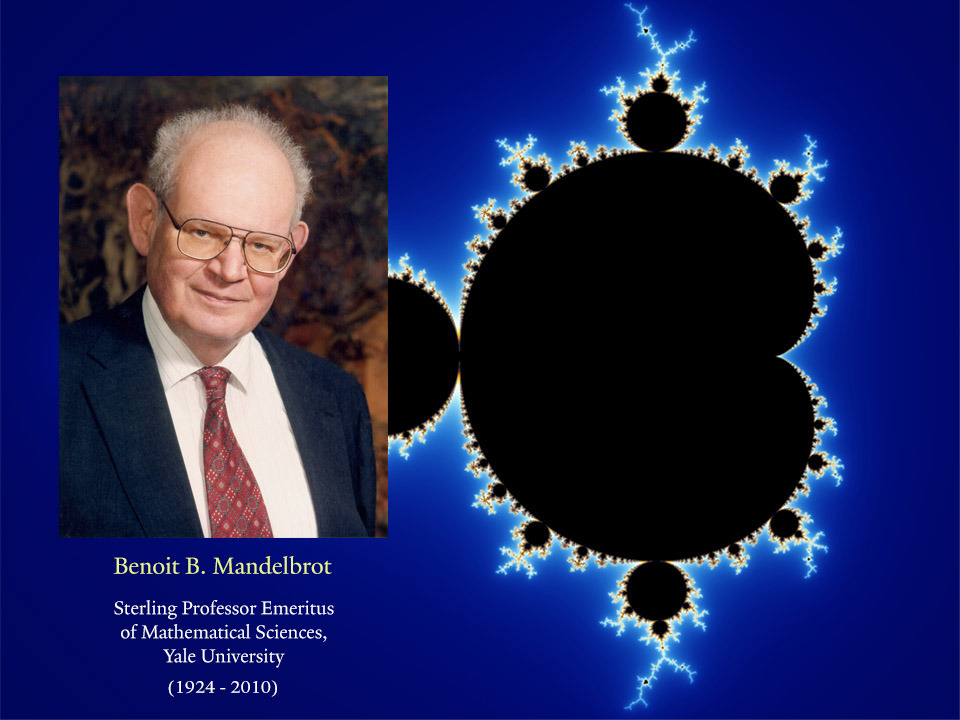
Some of you might be familiar with Quaternions which are much more commonly used than Tessarines. I first learned of the Tessarine ring from the 1991 book by Clyde Davenport “A commutative hypercomplex calculus for special relativity” which I found at the DeMerrit Library. At the time, I wasn’t really sure if the Tessarines would be all that helpful with relativity calculations and pedagogy; an opinion I still hold. Very interesting book none the less.
There’s something kind of exciting about the Tessarines. Like Quaternions, there are three imaginary numbers i, j, and k. However in Quaternion algebra, all three square to minus one. In the hypercomplex Tessarine algebra, k^2 = 1 !!! You have an imaginary number which when squared gives you 1, but it isn’t quite 1.. it’s 1 along an imaginary k axis. Multiplication is commutative, but there’s no unique inverse.
Anyway lets get to the eye candy. At that time, I approached the tessarine by making 2D slices of the the thing, painting the thing black, but using color to indicate the distance to the brot (in terms of how quickly the series diverges) and threw in some color cycling for effect. This gives two degrees of freedom behind the scenes because every point (w,x) defines a plane (y,z) which we then render as a 2d image. To make the videos, we cycle through these two free parameters a bit and of course zoom and color cycle into this strange creature.
The bits with square edges are actually Quaternabrot slices, they snuck in there along with all the shifty ghosting which is de rigeur when you dive deep into these kinds of structures.
20 years later we are back for more. Another approach is to build Tessabulb 3d images using the “distance to” algorithm along with ray tracing to render the thing in 3d sorta kinda.
Tessabulb
Mandelbulb flythroughs burst onto the rave and hardcore complex discrete math and hardcore fractal geometry scenes and captured the imagination of many, but due to complexity I didn’t dive in until relatively recently when I asked my pal large-matrix-of-numbers-chatbot for a little help.
In this case there is only one free paraeter, as every point zk defines a i,j,k volume of the tessabulb. Lets take a look at a flythrough of the tessabrot using this visualization technique on an expedition of spring 2026:
Return of the Tessabrot
I can’t wait to see more of this thing! Maybe in another 20 years I will be able to finally fly arround this thing with a real spaceship, perhaps go into 1e-25 on negative real axis and find a new homeland.